Is it actually a beach day?
A tiny tool that ranks nearby beaches by the conditions that actually make it worth going.
Why I built it
I live in the north of Portugal, where ‘sunny’ does not always mean ‘good beach day’… you can leave an inland area with blue skies and arrive at the coast to find cloud, wind and a completely different temperature.
Weather apps had all the data, but I still had to translate it into the only question I actually cared about:
So I built the answer I wanted.
One question, several signals
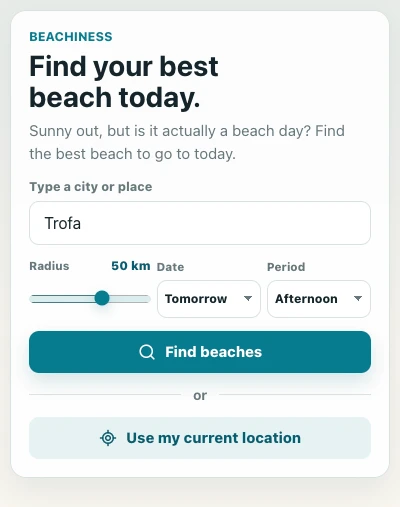
Beachiness only asks for a few things: where you are, how far you want to go, when you want to go, and roughly what part of the day you care about. Then it checks nearby beaches and turns a pile of weather signals into one ranked list.
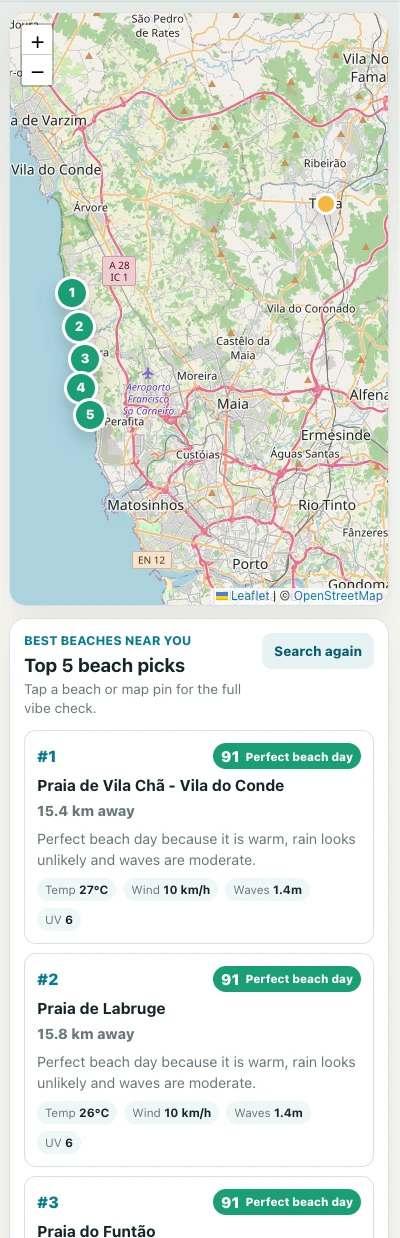
The score combines variables like temperature, cloud cover, wind, wave height, rain risk and UV, and it ranks the beaches and explains why each one scored the way it did.
The score is deliberately boring
There is no AI in the scoring, on purpose.
Each condition gets a weight, the scores are combined, and the result becomes a 0–100 Beachiness score.
The current weighting gives the most importance to temperature, followed by cloud cover and wind, with waves, rain and UV contributing to the rest.
The useful part was not finding the fanciest model. It was making the decision predictable, explainable and easy to trust.
From score to decision
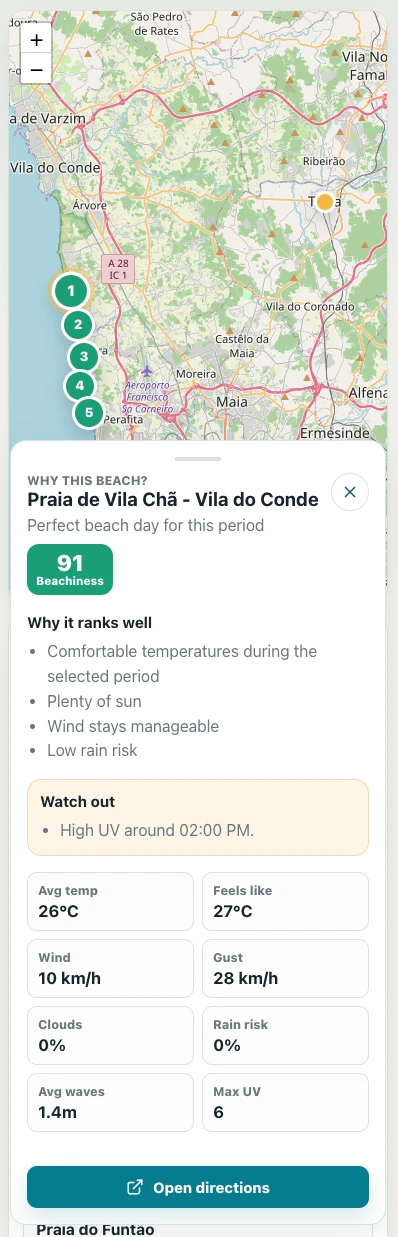
A number is not the decision. So Beachiness also explains why a beach ranks well, what to watch out for, and the conditions behind the score.
So instead of opening several forecasts and trying to combine them mentally, I get one ranked list and can still inspect the underlying conditions.
Small tool, finished problem
Beachiness was built for me. I was not trying to create a travel platform or a weather business. I just wanted to remove one recurring decision from summer weekends.
It is still live, and when I want to choose between nearby beaches, it does exactly what I built it to do.
What I learned
Compress the decision, not the data
The individual weather metrics were already available.
The weather data already existed. The useful part was turning it into the decision I actually wanted to make.
Not every problem needs AI
A transparent scoring function was simpler, cheaper and easier to trust than a model would have been. The least exciting technical choice was the better product choice.