Interview prep that remembers more about you than your CV does.
A tool I built to make interview preparation more contextual, personal and useful over time.
Why I built it
I first noticed the problem at a university career fair. I was there representing my company and spent the day talking with students preparing for their first jobs. Different conversations kept coming back to the same problem: people had projects, coursework, internships and real experiences, but often struggled to understand what was actually worth talking about, and how to turn it into a convincing story.
Around the same time, a few people close to me were going through exactly that. There were already plenty of AI interview simulators and CV reviewers. What I couldn’t find was something that became more useful the more it got to know the candidate.
So I started wondering what interview prep could look like if the system learned not only from a CV and a job description, but also from the person’s actual experiences and the way they communicate.
That became Interviewish.
More than a question generator
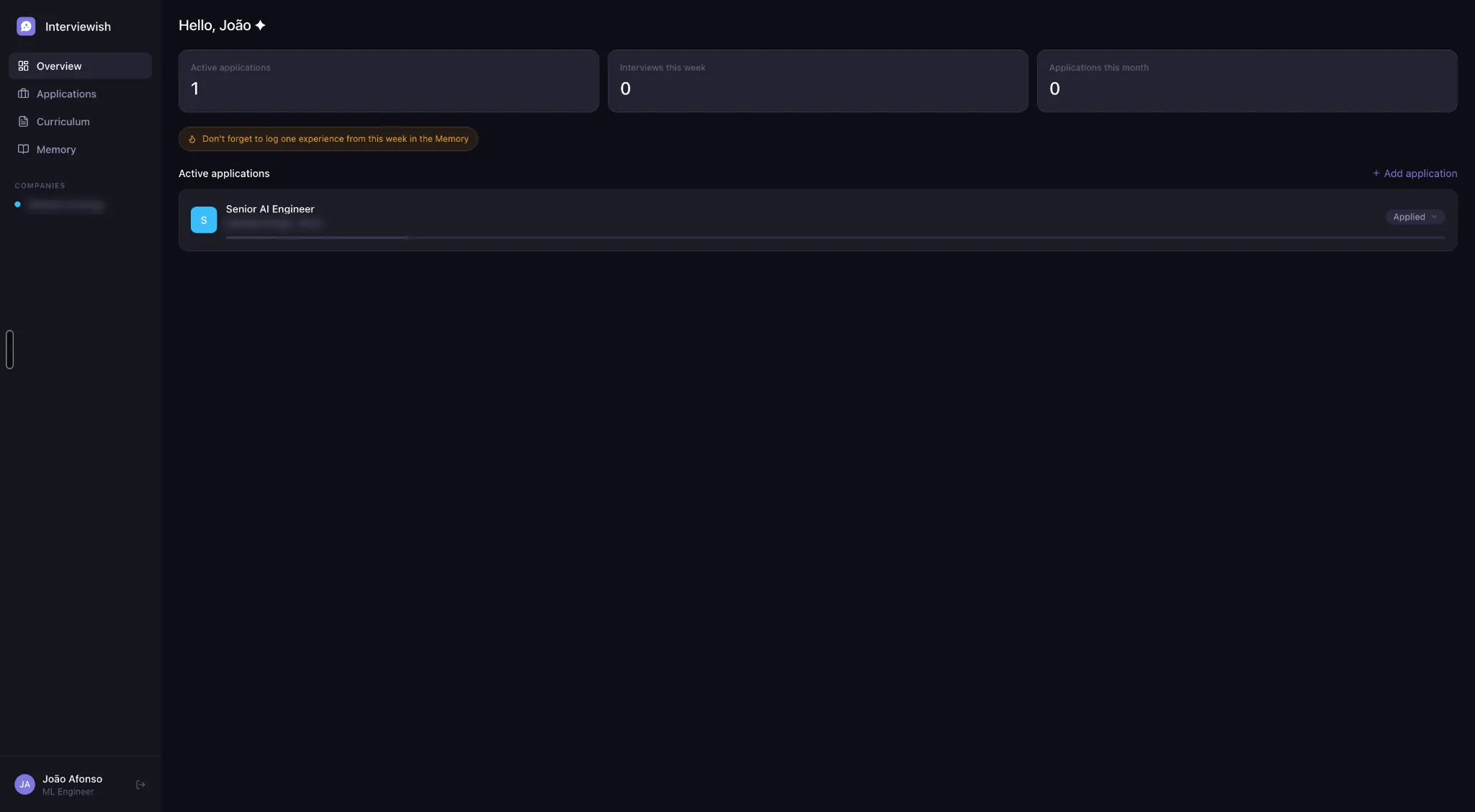
Interviewish is a workspace built around a real job opportunity. A user creates an account, adds a role, uploads a CV and prepares specifically for that application.
From there, they can:
- get general CV feedback;
- get CV feedback tailored to a specific role;
- prepare with extra context about the job and, when available, the company;
- run technical, functional or cultural mock interviews;
- choose between normal and roast feedback;
- answer by text or voice;
- get feedback directly inside the interview flow.
The point was to actually help someone connect their actual experience to the job they were trying to get instead of simply generating a list of questions.
Practice, then fix it immediately
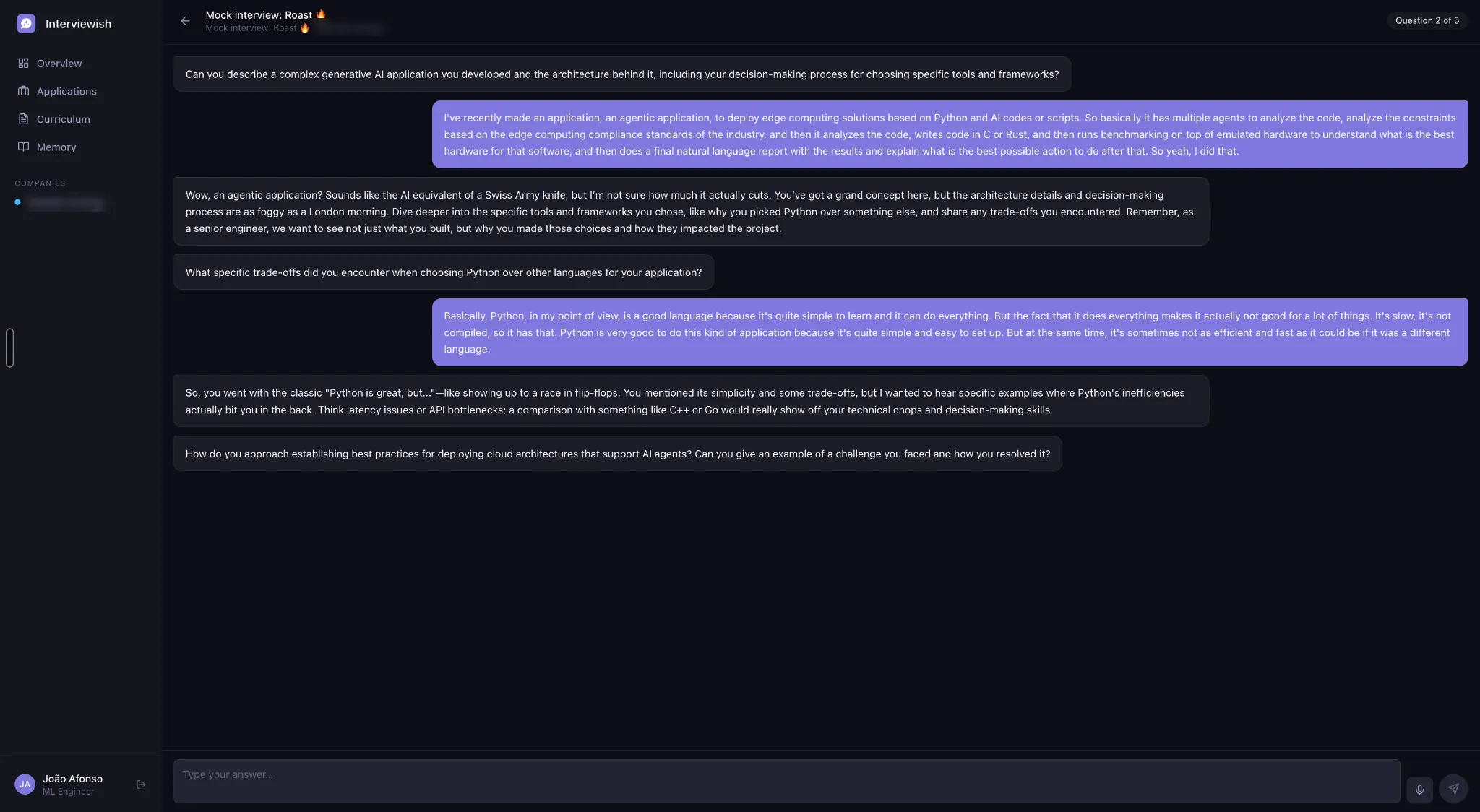
The interview flow is deliberately conversational: users can choose between technical, functional and cultural interviews, then answer each question by text or voice.
Feedback arrives directly in the conversation, so they can immediately see what worked, what was missing, and what they probably should not say again before moving on.
The roast mode doesn’t change the substance of the feedback, it just removes some of the politeness and makes it funnier!
Grounded in the actual opportunity
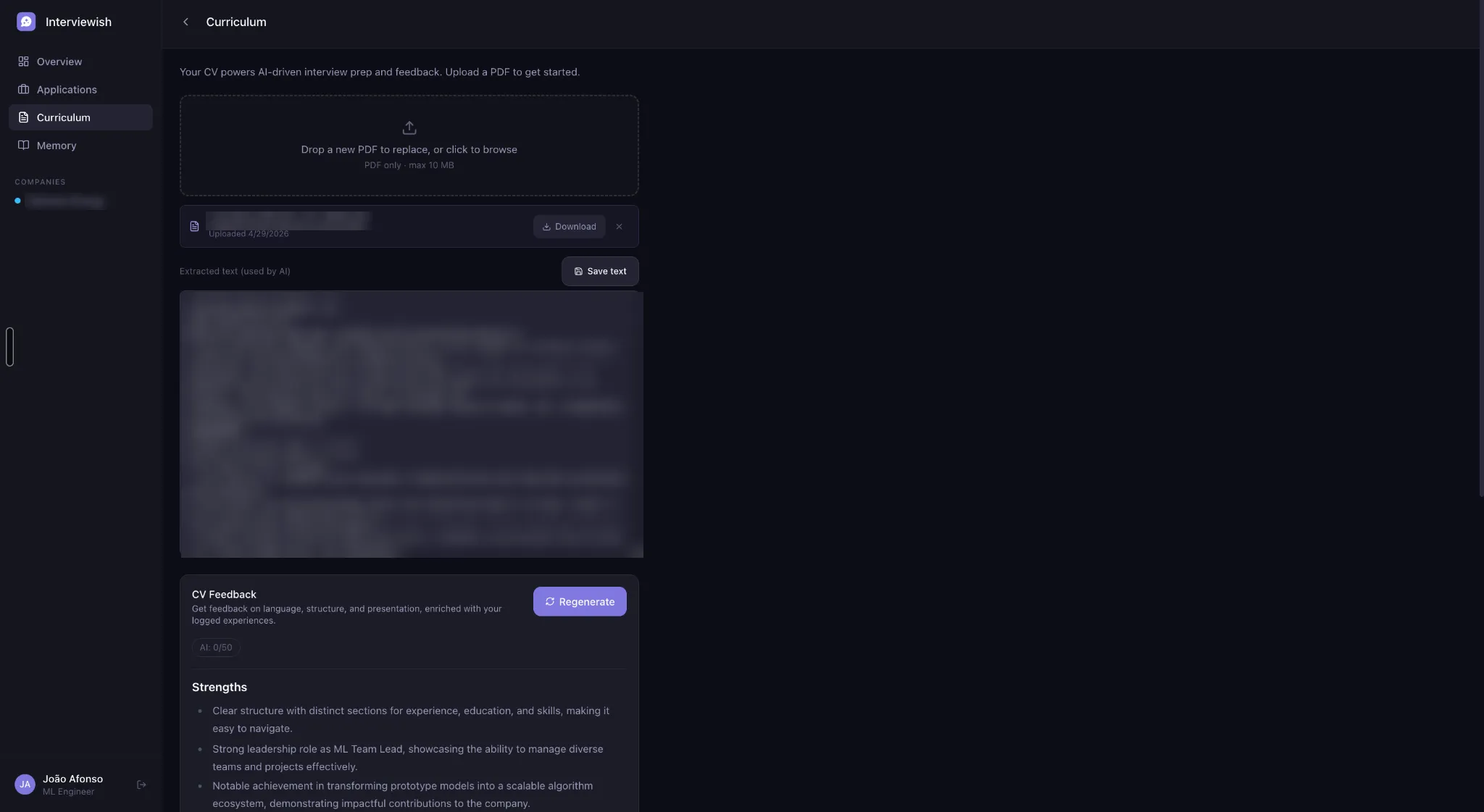
Interviewish can review a CV on its own, but it becomes much more useful when that CV is paired with a specific role.
That moves the feedback away from generic advice and towards what the actual opportunity is asking for.
The interesting part was the memory
My main technical interest while doing this was to learn more about personalization and memory. So the main goal was to decide what the system should remember about the person.
Explicit memory
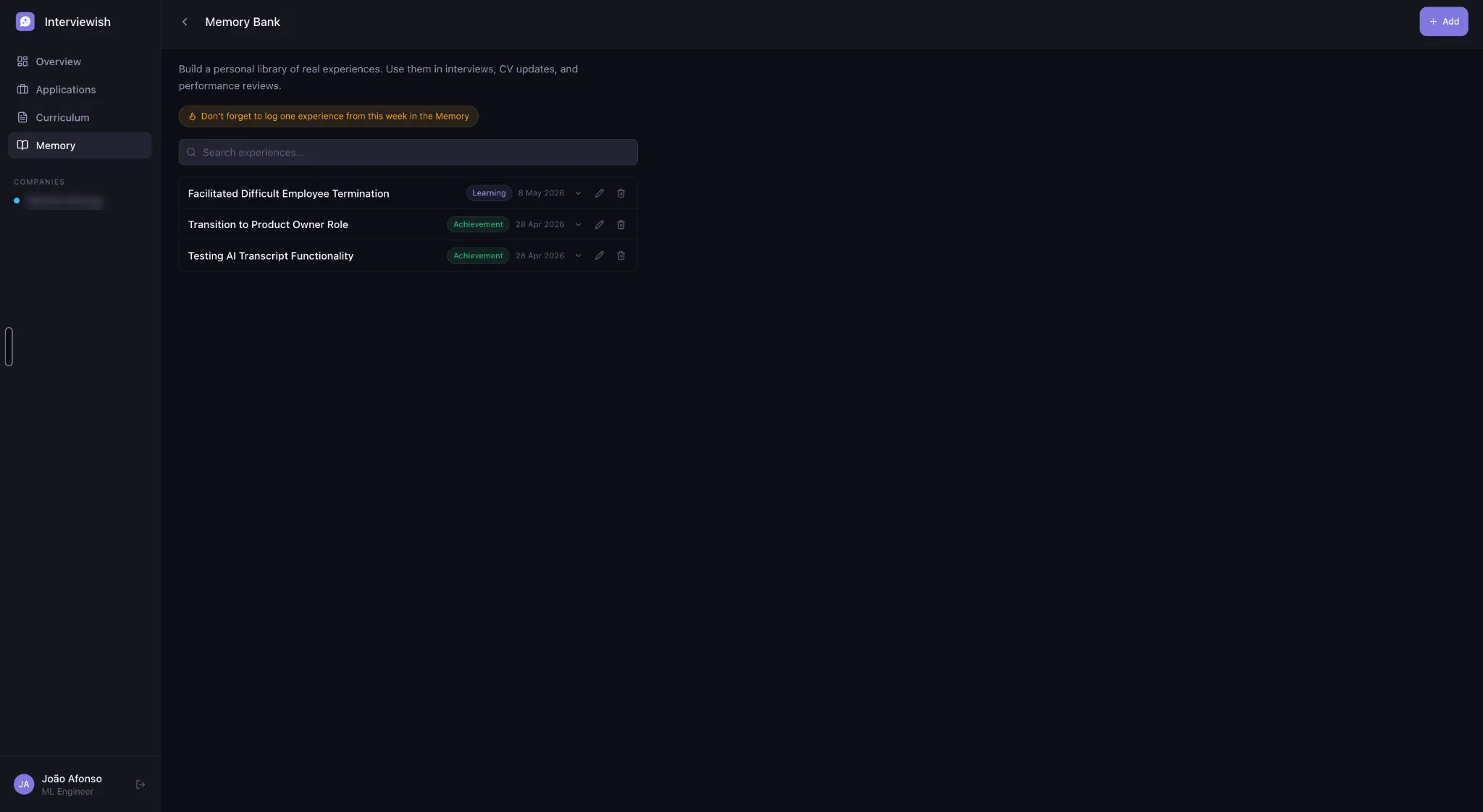
The Memory Bank is fully visible and user-controlled. Users can save wins and learnings from their work over time, by text or voice, even when they are not actively looking for a new job.
These are often exactly the things that never make it into a CV but suddenly become useful six months later when someone asks “Tell me about a time when…”
Implicit personalization
Separately, Interviewish learns recurring patterns from interview responses. For example:
- someone may consistently keep answers too high-level and lose useful detail;
- someone may use strong technical language but struggle to connect the pieces into a clear overall story.
These patterns are not shown back as some slightly creepy personality profile but they stay in the background and only matter when they can make future feedback better. What I really wanted was to make personalization feel like continuity rather than surveillance!
Making it a real product
I wanted to take Interviewish past the “cool prototype” stage, so I decided to also build all the other less exciting things:
- authentication;
- usage limits;
- a free tier;
- paid usage;
- one-off purchases;
- subscriptions;
- Stripe integration;
- deployment and cloud infrastructure.
Monetization was never really the point! The paid layer mostly existed because AI calls cost money and, unfortunately, I’m not rich and infrastructure providers have not yet agreed to accept enthusiasm as payment.
Where it is now
Interviewish is still live and usable. It was used by a few dozen people, including people outside my immediate network, but I never pushed it as a serious consumer business.
At some point, I stopped actively expanding it because it had already answered the question I originally wanted to explore.
People could use it, people I knew got real value from it while job hunting, and the product had reached the stage where keeping it useful made more sense than adding features forever.
What I learned
Memory needs curation
Remembering more does not automatically mean understanding someone better. Useful memory depends on deciding what should survive a session, what should stay visible and what should quietly disappear.
Personalization has a creepiness threshold
Good personalization should feel like continuity. The moment the user starts thinking “wait, how does it know that?”, the experience changes.
Shipping changes the engineering problem
A prototype can stop at a good AI interaction but that’s not a real product. Authentication, payments, limits, deployment, costs and reliability quickly become part of the product too. Less exciting, equally real.